
And why it’s time for us all to take a stand.
by Richard Cawte
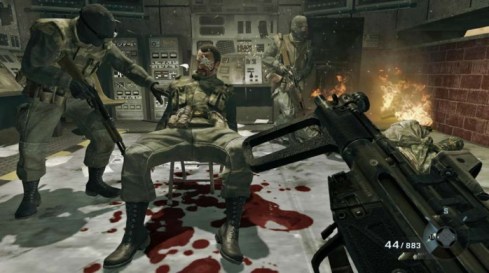
In February this year a 16 year old British boy was found dead with his hands tied behind his back and a plastic bag over his head. He had committed suicide. An A-level student who didn’t drink or smoke, his father described him as a seemingly-happy child.
Nothing about him caused concern. He never threatened self-harm. He had exams coming up but that wouldn’t worry him as he was a straight-A student. He enjoyed playing his X-box. The game he always played was Call of Duty.”
The coroner at the boy’s inquest last week, Mr John Pollard, has decided to investigate the nature of the computer game, claiming that it has had a direct influence in the deaths of three other teenagers during the past several years, including one 14-year old boy who hanged himself.
After three or four inquests into the deaths of teens,” he said, “the Call of Duty game seems to be figuring in recent activity before death. It concerns me greatly.”
I welcome his comments and share his concerns.
Call of Duty has sold over 100 million copies worldwide. I’m told it is a very violent game and although I’ve never seen a second of it I’d like to warn all parents out there to take action and simply stop allowing your kids to play such things. If you think I should give it a go before making such a comment, my reply is that there are some things in life (heroin for instance) that you just don’t need to experience to know that they aren’t good for you.
The sub-conscious mind cannot distinguish between reality and fiction
Why is extreme simulated violence something to avoid? Because the sub-conscious mind cannot distinguish between something that is “real” – i.e. a murder happening in front of you – and something that is “fictional” – i.e. a scene on a screen. You only have to look at how many soap opera actors receive letters to their screen-selves to know this is true.
The subconscious mind stores each and every image/word/smell/taste and other sensory experience that we ever have; every one, our whole life long.
Unfortunately it can easily be manipulated or controlled. Images can induce immediate action that would appear to be contradictory to normal behaviour for that individual. Words, phrases or sounds can do the same thing. Advertising agencies the world over make a living from that fact.
And so do the makers of violent computer games.
How violent images traumatise and create addiction
When you repeatedly bombard the brain with images of simulated violence you are in effect applying repeated trauma to yourself, your fight-or-flight mechanism is activated and adrenalin is pumped through the system.
We all have a fight-or-flight mechanism. It is there to help us escape from threat or capture food. Under normal circumstances, this would be part of a learning process. You would run from a tiger or chase possible prey. After a short burst of activity the need for adrenalin would pass. You would breathe heavily and relax. During this period your subconscious mind would file away the lesson it has learned in order to replay it via the neo-cortex when the circumstances are repeated. At the same time, feel-good chemicals rush through your body, assuming you have either escaped death or caught your supper.
The problem with screen activity is that it is sedentary. You don’t run the adrenalin off. You store it away instead. So ultimately your physiological processes are hijacked. Unable to tolerate repeated activation of the fight-or-flight mechanism (with no physical exertion to follow) your brain switches it off, allowing you to move into a trance from which it is hard to break free.
That’s how computer games become so addictive.
In these moments of extreme adrenalin-rush, the brain is working overtime. Forced to process many millions of bytes of information in a second, it hands over control entirely to the subconscious, because the subconscious is much more powerful and also because there is no need to be analysing logical data. This processing leads to neural pathways being established and those neural pathways form our beliefs.
Computer games may be sedentary but they are not passive. The player takes part in the action. If the action is violent, violence becomes a part of the subconscious. Very quickly the subconscious forms beliefs based on what it is experiencing. One of those beliefs appears to be that “real world” violence is no more damaging than virtual-violence. In some cases this appears to provoke players into suicide. In others it leads them to murder.
Take the case of Norwegian Anders Breivik who showed no remorse as he spoke of how he trained himself to become a killer by playing Call of Duty. In his case, 77 people was what it took to satisfy his addiction. In 2012 Mohamed Merah went on a killing spree in Toulouse immediately after playing Call of Duty. In this case the death toll was “only” 7.
My child’s friends are playing it so it must be OK
These men were both adults. But what of children who are being exposed at younger and younger ages to licensed brutality? Games creators will say that any game with a certificate-18 should not be played by anyone under that age (I’d argue that it shouldn’t be played by anyone at all) but we all know these certification guidelines are not enforced.
When Grand Theft Auto IV was launched it sold millions of copies almost overnight. Another violent game, a primary school teacher friend of mine told me boys as young as seven were playing it their school, usually with their parents’ permission.

This really concerns me. We know that children’s minds are even more open than ours. The imaginary IS real to them. Allow them to plug into the world of computer game violence and we are brutalising them just as much as if we were abusing them ourselves. At best we are traumatizing them. At worst we are flicking a switch that will increase the likelihood of them committing either murder or suicide.
My guess is that in thirty years time parents in the west will look back and shudder at what they allowed their children to experience. By then, the evidence linking violent computer game playing and real world violence will be irrefutable. But you don’t have to wait until then.
I have three children of my own. Having studied the impact on both mind and body of staring at a screen for hours (irrespective of the type of content being shown) I put a strict limit on TV-viewing and a total ban on computer games in our household. I figured that my kids would be healthier without them. The ban extended to any gadgets their friends might bring in too. Mobile phones are also switched off at meal times.
Many other parents raised an eyebrow at my actions and one or two suggested that perhaps I was stunting the children’s chances to communicate with their peers. I’m happy to say I’ve not noticed this to be the case.
My kids weren’t stigmatized by not having the latest X-box. They weren’t ostracized or shunned. Yours won’t have to be either. We just have to teach them a little bit of the science; explain to them that simulated violence is no different to real world violence from the subconscious mind’s point of view.
We have to take responsibility, to be good parent not lemmings, knowing we’re being far more loving than if we just let them play whatever new game is in vogue.
If our kids remonstrate with us in the short term, let’s be big enough to take it on the chin. They will thank us for it in the years to come.
Additional resources:
Read this letter that a gamestore sales assistant wrote to parents:
I Sold Too Many Copies of GTA V To Parents Who Didn’t Give a Damn
guardian.co.uk – Grand Theft Auto 5 under fire for graphic torture scene
bbc.co.uk – Wisconsin girls charged with ‘Slenderman’ stabbing
 Health Aware